
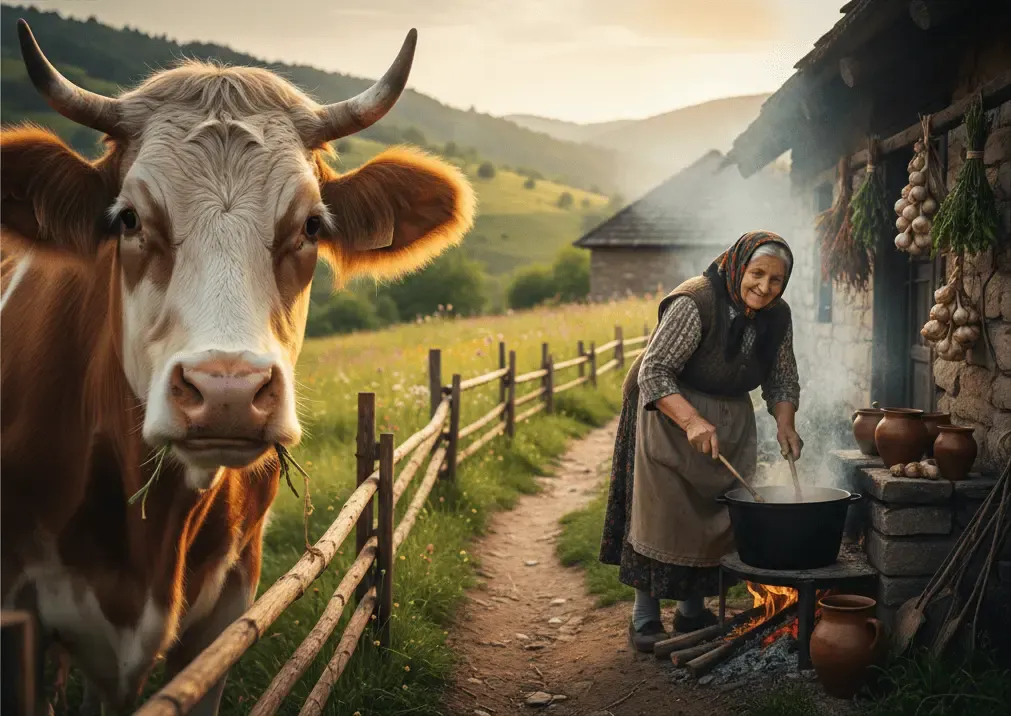
I’m Venezuelan. I moved to Croatia. I’m learning Croatian.
This means my brain is constantly playing a game called “Is this a real word or am I about to accidentally insult someone?”
Today’s episode: Baka vs Vaca.
The Innocent Beginning
My first week in Zagreb, a Croatian friend gets a phone call. He hangs up and says:
“Moja baka dolazi sutra!”
I nodded politely.
Then my Spanish brain processed what it heard.
Did… did he just say his cow is coming tomorrow?
The Linguistic Plot Twist
Here’s the thing about Spanish speakers — we have a complicated relationship with the letter V.
We don’t pronounce it like English speakers do. For us, V sounds like B.
- Venezuela? More like Benezuela.
- Valencia? That’s Balencia.
- Vino? You guessed it — Bino.
Now combine this with the fact that in Spanish (and Croatian, and many other languages), C followed by A, O, or U makes a hard K sound.
So when a Croatian says baka…
A Spanish speaker hears vaca.
And vaca in Spanish means cow.
| Croatian | Spanish | What my brain hears |
|---|---|---|
| Baka | Vaca | Cow |
| Moja baka | Mi vaca | My cow |
| Volim baku | — | I love cow??? |
Why This Is Worse Than You Think
Now, calling someone a cow in Spanish isn’t exactly a compliment.
Vaca doesn’t mean “cute fluffy farm animal” in casual conversation.
It means… well… you’re fat.
And since vaca ends in -a, it’s specifically aimed at women.
So every single time a Croatian lovingly mentions their baka…
My brain hears them calling an elderly woman fat.
“Moja baka pravi najbolji kolač!” (My grandma makes the best cake!)
My brain: “My fatty makes the best cake!”
Grandma would NOT be happy.
Real Situations That Broke My Brain
Scenario 1: The Introduction
Croatian friend: “This is my baka!”
My brain: Why is he introducing me to his cow? And why is she offering me rakija?
Me: nervous smile “Drago mi je…”
Scenario 2: The Photo
Colleague: “Look, here’s a photo of my baka when she was young.”
My brain: That’s a very elegant cow.
Me: “She looks… lovely.”
Scenario 3: The Recipe
Friend: “This is my baka’s recipe.”
My brain: The cow has recipes?
Me: questioning everything
The Reverse Problem
Of course, this works both ways.
Imagine a Croatian learning Spanish, proudly talking about their grandmother:
“Mi baka es muy simpática.”
Every Spanish speaker in the room: 😳
“Did… did you just call your grandma a cow?”
What I’ve Learned
After months of hearing about bakas, I’ve trained my brain to make the switch.
But every now and then, someone will mention their baka in conversation, and for a split second — just a split second — my inner Venezuelan goes:
Cow.
And then I smile, nod, and ask how baka is doing.
Because here’s the truth about learning a new language in a new country:
Your brain will betray you. Your instincts will fail you. And sometimes, grandmothers will temporarily become livestock.
But that’s okay.
Because now, whenever I hear baka, I think of warm kitchens, homemade food, and the kind of unconditional love only a grandmother can give.
And also cows.
But mostly grandmothers.
So if you didn’t know that Croatian grandmas sound like Spanish cows…
Well, now you know.
And if you’re a Spanish speaker moving to Croatia, just remember:
When someone talks about their baka, they’re not being rude. They’re just being Croatian.
And their grandmother probably makes excellent kolač.