
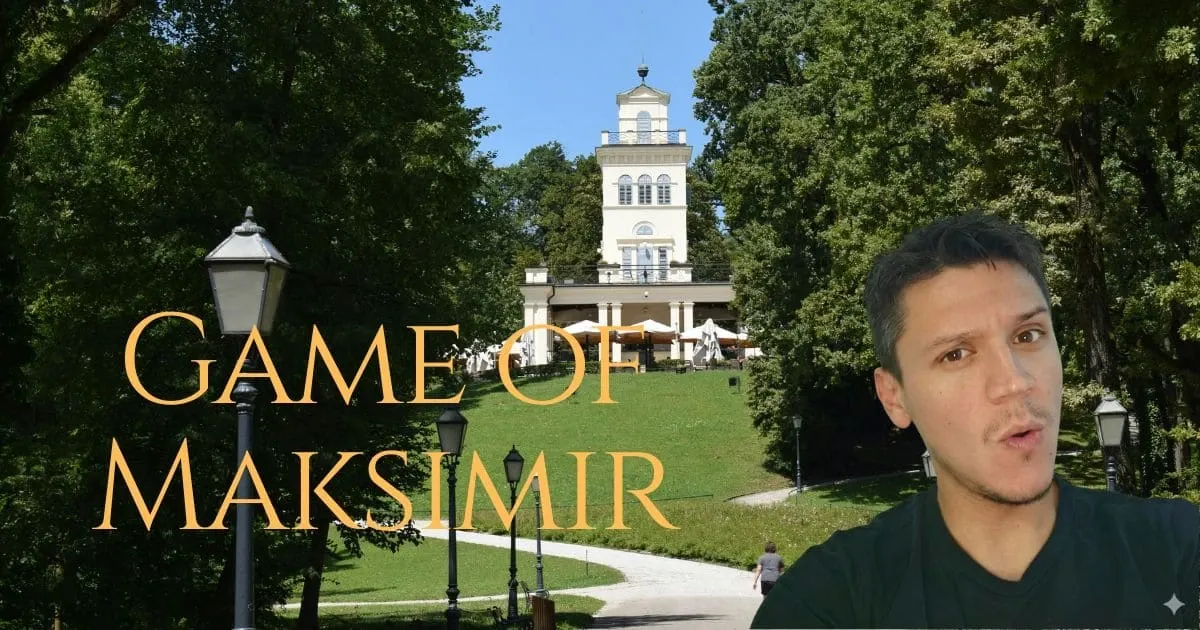
Welcome to Maksimir Park — the green oasis that looks peaceful on Instagram but actually contains more political intrigue than Game of Thrones. As someone who moved to Zagreb expecting parks to just be… parks, I was absolutely not prepared for this historical soap opera disguised as a picnic spot.
Let me walk you through 200 years of drama, one tree at a time.
The Visionary Bishop Who Got Too French
It all started with Bishop Maksimilijan Vrhovac in the late 1700s. This was a man who looked at God’s creation and said, “Yeah, but have you seen French landscape geometry?”
Vrhovac wanted Maksimir to be a mini-Versailles right here in Zagreb. We’re talking straight lines, perfect symmetry, meticulously trimmed hedges — total Enlightenment era energy. The man had a vision, and that vision involved rulers and protractors.
But here’s where it gets spicy.
The Habsburgs started getting nervous. “Hmm… he’s building a public park… with French influences… Is he a Mason? A Jacobin? A dangerous intellectual spreading revolutionary ideas through shrubbery?”
So they shut him down.
Yes, friends — Maksimir is literally an unfinished Enlightenment project. The next time someone asks why part of the park feels different from the rest, you can casually drop this historical tea.
Enter the Romantic Rebranding
After Vrhovac’s dreams were crushed by imperial paranoia, Archbishop Juraj Haulik stepped in. New boss, completely new vibe.
Haulik walked into Maksimir planning meetings like: “Lose the geometry. We’re going full Romantic era now. I want soft lines, dreamy lakes, weeping willows… give me the Pinterest version of nature.”
And honestly? He delivered.
But Haulik had one small issue: a massive ego. He tried to rename the entire park after himself — “Jurjaves.”
Zagreb citizens collectively responded with “Yeah, no.”
The name Maksimir won the popularity contest, and Haulik had to deal with his park being named after his predecessor. The pettiness of history is truly unmatched.
The Most Masonic Thing You’ll See in a Croatian Park
Here’s where it gets deliciously ironic.
Remember how Vrhovac was accused of being a Mason and had his project shut down? Well, Haulik — the man who took over — went ahead and built an Egyptian obelisk right in the middle of the park.
Yes. An actual obelisk. In Zagreb. In a Romantic European garden.
Nothing says “I’m definitely not into secret societies” like erecting a giant ancient Egyptian sun symbol that’s basically the Masonic starter pack. The audacity. The drama. I’m obsessed.
Hidden Gems You’ll Actually Want to Find
Beyond the main drama, Maksimir is packed with weird and wonderful spots:
The Echo Pavilion (Jeka)
A small pavilion that literally repeats your secrets back to you. Stand in the right spot, speak, and hear your voice bounce back. It’s basically 19th-century surround sound, and yes, I spent way too long testing it with increasingly ridiculous phrases.
The Swiss House (Švicarska Kuća)
A cozy Alpine chalet built so that 19th-century city dwellers could pretend they were living the simple mountain life — for approximately five minutes before returning to their urban routines. It’s the original “cottagecore aesthetic” content, just 150 years early.
Steamships and Trains (Yes, Really)
Fun fact that absolutely broke my brain: Maksimir once had steamships on its lakes and a small railway. Your peaceful Sunday picnic spot used to be an industrial playground. The Victorians were wild.
The Patriotic Dirt Smoothie
Then there’s the Mogila — a mound that might look like just a hill, but is actually built with sacred soil collected from historically significant sites across Croatia.
It’s essentially a patriotic dirt smoothie topped with a falcon sculpture. Every time I walk past it, I think about how someone had to coordinate the logistics of collecting soil from multiple locations and artfully arranging it into a symbolic mound. 19th-century nation-building was a whole aesthetic.
Zagreb Zoo: From Six Animals to Icon Status
Tucked inside Maksimir is the Zagreb Zoo, which has one of the most humble origin stories in zoo history.
It started with three foxes and three owls. That’s it. Six animals total. “Come see our zoo!” they said, knowing full well you could count the entire collection on your fingers.
But from those modest beginnings emerged legends — like Dokana the orangutan, who became the original grumpy Zagreb neighbor. She had a face that said “I’ve seen things” and a personality that made her a city celebrity.
Meet Dedek: The 600-Year-Old Oak Who’s Seen Everything
Deep inside Maksimir stands “Dedek” (Grandpa in Croatian) — a massive oak tree that’s approximately 600 years old.
Let that sink in. This tree was already a century old when Columbus sailed to America. It has witnessed:
- The rise and fall of empires
- Multiple wars
- Countless Zagreb love stories and breakups
- The invention of everything from the printing press to TikTok
And here’s the wildest part: scientists are actively cloning Dedek. They’re taking genetic material to ensure this legendary tree’s DNA lives on. That’s right — this oak is so iconic, it’s getting the immortality treatment.
When I tell you Croatian parks hit different, I mean it.
What Maksimir Actually Teaches Us
Every time I walk through Maksimir now, I see it completely differently. It’s not just “a nice park” — it’s a physical timeline of:
- Political paranoia (poor Vrhovac and his French garden dreams)
- Ego battles (Haulik’s failed rebranding attempt)
- Architectural irony (that obelisk will never not be funny)
- National identity formation (the symbolic Mogila)
- Humble beginnings (six animals, infinite ambition)
Practical Info for Your Visit
Getting there: Trams 11 and 12 drop you right at the park entrance. You can also take bus 201 or 203.
Best time to visit: Early mornings for peaceful walks, weekends for people-watching. The zoo is open daily from 9 AM.
Don’t miss:
- The Echo Pavilion (bring your best echo-worthy phrases)
- Dedek the ancient oak (pay your respects)
- The viewpoint near the Fifth Lake
- The zoo, especially if you appreciate ironic origin stories
Time needed: Plan at least 2-3 hours to explore properly. The park is massive (over 300 hectares), so wear comfortable shoes.
So yeah — next time you walk through Maksimir, remember: you’re not just in a park. You’re walking through a historical soap opera with trees.
And honestly? That’s exactly what makes Zagreb special. Even the green spaces have layers of drama, irony, and stories that nobody warned you about.
Stay tuned for more weird history and actually useful tips about this gloriously chaotic city.